
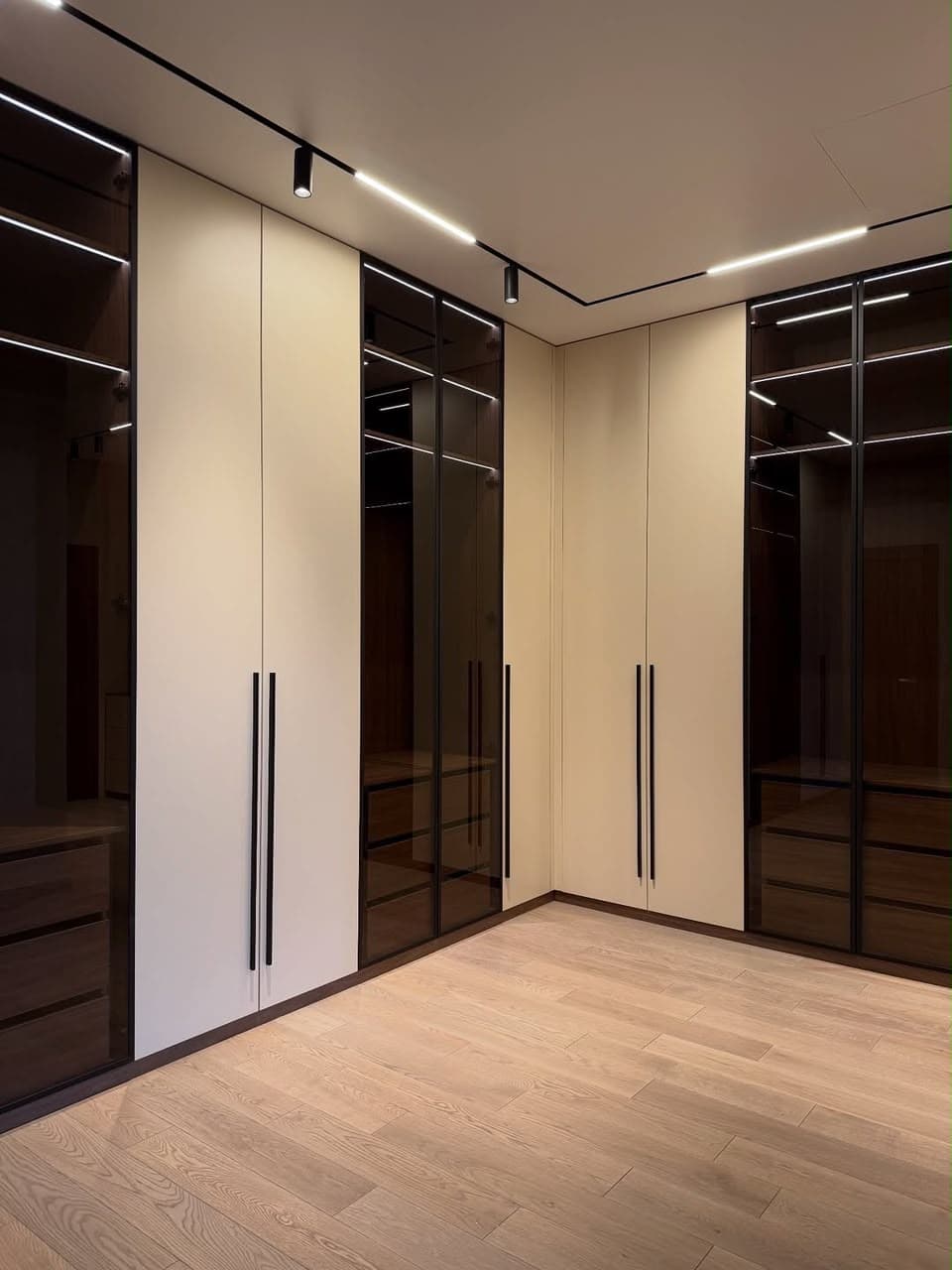
Bespoke architectural joinery is the defining element of true luxury in modern UAE homes. From custom-built walk-in wardrobes to acoustic wood panelling, expertly crafted millwork transforms a standard property into a distinctive, high-value space in a way that loose, imported furniture simply cannot replicate. This guide explains what architectural joinery actually is, why it matters so much in the UAE market specifically, and what separates joinery that lasts fifteen years from joinery that starts failing within two.
What Is Architectural Joinery?
Unlike loose furniture — a sofa or dining table you could theoretically take with you when you move — architectural joinery refers to timber items that are built into the structure of a building. This includes fitted kitchens, walk-in wardrobe systems, vanity units, intricate staircases, built-in TV and media walls, home office cabinetry, and specialized wall claddings and acoustic panelling. In the UAE's high-end real estate market, custom joinery is effectively non-negotiable for achieving a premium finish, because a room's proportions, door placements, window reveals and service risers are never quite standard — off-the-shelf cabinetry either leaves awkward gaps or requires the room to be compromised around it, whereas custom joinery in Dubai and Abu Dhabi is measured and manufactured to fit the exact space.
Why Joinery Quality Matters More in the UAE Than Almost Anywhere Else
Two features of the UAE's environment make joinery quality a much bigger differentiator here than in, say, temperate Europe. The first is climate: sustained high heat and fluctuating indoor/outdoor humidity put real stress on timber, veneers, adhesives and hardware, so joinery that isn't engineered for this climate visibly fails faster — doors warp, veneer lifts at the edges, and soft-close mechanisms stiffen. The second is market expectation: the UAE's luxury residential and hospitality market has trained buyers and tenants to expect European-standard finishes, so joinery that would pass unnoticed in a mid-market property elsewhere reads as a shortfall here. Together, these two facts mean the gap between good and mediocre joinery shows up faster and matters more in Dubai and Abu Dhabi than in most other markets.
Precision Manufacturing: Why In-House Production Changes the Outcome
At Bait Al Ebdaa, custom joinery for Dubai and Abu Dhabi projects is manufactured in-house at a dedicated 15,000 sq ft facility in Ajman, using German CNC machinery and sustainably sourced European timber. In-house production — as opposed to outsourcing to a third-party carpentry subcontractor, which is how many "design-only" interior firms actually deliver joinery — matters for three concrete reasons:
- Perfect fit: Laser-measured templates taken directly from the finished site (not from the original architectural drawings, which rarely match as-built reality exactly) ensure millimeter-perfect installation, with consistent reveals and gaps across every door and drawer front.
- Premium, consistent finishes: From high-gloss polyurethane lacquer to natural wood veneers and matte thermofoil, dedicated finishing booths with controlled spray environments deliver a flawless, uniform sheen across an entire run of cabinetry — something very difficult to achieve with finishing done on-site.
- Faster problem-solving: If a panel is damaged in transit or a measurement needs adjusting mid-installation, an in-house factory can produce a replacement in days. A subcontracted joinery supplier working through an intermediary can add weeks to that same fix.
What Separates Good Joinery From Great Joinery
Several details distinguish joinery built to last from joinery that looks fine on handover day but degrades within a year or two:
Substrate and Core Material
Moisture-resistant (MR) or marine-grade MDF and plywood cores resist the UAE's humidity swings far better than standard-grade board, particularly in kitchens, bathrooms and any joinery near a balcony or window with frequent air-conditioning cycling.
Edge Banding and Sealing
Exposed board edges are where moisture first penetrates a panel. Properly sealed, tightly bonded edge banding — especially on cut-outs for hardware and services — is one of the most overlooked but most important details in humid-climate joinery.
Hardware Specification
Soft-close hinges and runners rated for high-cycle, humid-environment use (rather than generic imported hardware) determine whether drawers still glide smoothly after three years of daily use in air-conditioned interiors.
Veneer and Grain Matching
On a run of wardrobe or kitchen doors using natural wood veneer, grain-matching across panels — so the timber pattern flows continuously rather than jumping between adjacent doors — is a manufacturing discipline that separates a considered joinery package from a rushed one.
Where Bespoke Joinery Delivers the Most Value
- Kitchens: Handle-less, soft-close cabinetry with integrated appliance panels remains the single highest-impact joinery investment in a UAE villa or apartment.
- Walk-in wardrobes: Custom internal configurations — drawer-to-hanging ratios, jewellery trays, shoe racking — that match how a specific household actually dresses, rather than a generic layout.
- TV and media walls: Cable management, ventilation for AV equipment, and acoustic considerations built into the joinery from the design stage rather than retrofitted.
- Home offices: Increasingly requested since 2023, with integrated cable routing, printer storage and video-call-appropriate backdrop panelling.
Bespoke Joinery and Property Value
Beyond daily livability, investing in bespoke joinery has a measurable effect on resale and rental positioning in Dubai's luxury market, where listing photography and viewings routinely foreground kitchen and wardrobe quality. Agents and appraisers in the villa and premium apartment segment consistently point to fitted joinery quality as one of the fastest ways a buyer or tenant distinguishes a genuinely renovated property from one with a surface-level refresh, often ahead of more visible factors like wall color or lighting fixtures, precisely because joinery quality is harder to fake with a quick cosmetic refresh.
The Design Process, From Consultation to Manufacturing
Bespoke joinery isn't ordered off a catalog — it moves through a defined design sequence, and understanding it helps set realistic expectations for timeline and involvement.
1. Consultation and Brief
An initial discussion establishes how the space is actually used — how a household dresses and stores clothing for a wardrobe project, or how a kitchen is used for cooking versus entertaining — since joinery configured around real usage patterns outperforms joinery configured around generic assumptions every time.
2. Site Measurement
Laser measurement of the as-built space, not the original architectural drawings, since real-world construction tolerances mean walls, floors and ceilings are rarely perfectly true — a discrepancy of even a few millimeters matters enormously in fitted joinery.
3. 3D Design and Material Selection
Photorealistic renders let a client see finish, handle hardware, internal configuration and lighting interaction before committing, with material samples (veneer, laminate, stone) reviewed physically alongside the digital render.
4. Shop Drawings and Sign-off
Detailed manufacturing drawings — including every internal division, hinge position and cable cut-out — are issued for final client approval before cutting begins, since this is the last point at which a change is inexpensive.
5. Manufacturing and Quality Control
CNC-cut panels move through edge-banding, finishing and hardware-fitting stages, with quality checks at each stage rather than only at final inspection.
6. Installation
Site installation by the same team responsible for manufacturing, which shortens the feedback loop if any on-site adjustment is needed.
Comparing Joinery Styles for UAE Homes
Three broad joinery aesthetics dominate the current Dubai and Abu Dhabi luxury market, and the right choice depends on the property's overall design language rather than trend alone:
- Modern handle-less: Push-to-open or integrated channel-pull mechanisms create a minimalist, seamless facade — currently the dominant style in new-build villas and apartments across Dubai.
- Classic and transitional: Shaker-style panelling, visible hardware and natural wood veneers suit villas with a more traditional or Mediterranean architectural language, particularly in established communities like Emirates Hills and Jumeirah.
- Mixed-material contemporary: Combining matte lacquer, natural stone inlays and brushed metal detailing, popular in larger statement kitchens and media walls where the joinery itself functions as a design centerpiece rather than a background element.
What Drives the Cost of Bespoke Joinery
Joinery pricing varies more than most clients expect for what looks like a similar finished product, and the variance comes down to a small number of factors: the complexity of internal configuration (a wardrobe with extensive internal drawer and accessory fittings costs meaningfully more than open hanging space), the finish tier (natural veneer and high-gloss lacquer sit above laminate and matte thermofoil), hardware specification (soft-close, push-to-open and motorized elements each add cost over basic hinges and runners), and linear meterage — simply, the total run length of cabinetry being manufactured. Indicative starting prices by joinery category are published on our pricing page, with a firm quotation following site measurement.
Sustainability in Joinery Manufacturing
Sourcing timber and board from certified sustainable suppliers, minimizing offcut waste through optimized CNC nesting software, and using low-VOC adhesives and lacquers are all specification choices available at the manufacturing stage without materially changing cost or lead time — worth raising explicitly with any joinery supplier during the consultation stage if sustainability is a priority for the project.
Joinery for Every Room: A Closer Look
Bathrooms and Powder Rooms
Vanity units in wet areas face the most concentrated moisture exposure of any joinery in a home, which makes fully sealed, moisture-resistant board and waterproof-rated finishes non-negotiable rather than optional upgrades. Integrated stone or composite countertops with minimal seams further reduce the risk of water ingress at joints over time.
Home Bars and Entertaining Spaces
Increasingly requested in Dubai and Abu Dhabi villas, custom joinery for a home bar typically integrates wine storage at controlled temperature and humidity, backlit display shelving, and durable, easy-clean work surfaces — a specification set closer to a small commercial fit-out than to standard living-room furniture.
Walk-in Pantries
A well-configured pantry uses adjustable shelving depth matched to actual storage needs — narrow shelves for spices and cans, deeper shelving for bulk and appliance storage — designed around a household's real shopping and cooking habits rather than a generic layout.
Home Offices and Study Rooms
Built-in desks with integrated cable management, printer and equipment storage, and acoustic-conscious material choices have become one of the most frequently requested joinery categories since 2023, reflecting how much home-based work has become a permanent fixture of UAE villa life.
Caring for a Bespoke Joinery Investment After Installation
The UAE's heat and humidity mean that even the best-built joinery needs consistent aftercare to perform for its full intended lifespan. Climate-adapted materials at the manufacturing stage significantly reduce the maintenance burden, but routine care — gentle cleaning, periodic hardware lubrication, and sensible sun and moisture management — remains part of protecting the investment long-term. Our detailed maintenance guide covers this room by room.
Popular Joinery Finishes Explained
Finish terminology gets thrown around loosely in consultations, so it's worth defining the main categories clearly. High-gloss polyurethane lacquer delivers a mirror-like, reflective surface that reads as strongly contemporary and shows fingerprints and dust more readily than matte alternatives, requiring more frequent light cleaning to stay looking pristine. Matte or satin lacquer offers a softer, fingerprint-resistant surface that has become the more popular choice in recent UAE projects for exactly that lower-maintenance reason. Natural wood veneer brings genuine timber grain and warmth at a lower cost and lighter weight than solid timber, while requiring the UV and moisture care outlined in our maintenance guide. High-pressure laminate (HPL) and thermofoil finishes offer the most durable, scratch- and moisture-resistant surface at the most accessible price point, making them a common choice for high-traffic joinery like kitchen cabinetry in family households.
In-House vs. Subcontracted Joinery: A Buyer's Checklist
Not every company that sells "custom joinery" in Dubai actually manufactures it. Many interior design and fit-out firms design joinery in-house but subcontract manufacturing to a third-party carpentry workshop — which isn't necessarily a problem, but it does change what a client should ask before committing. Worth confirming directly: where is the joinery actually manufactured, and can that facility be visited? What happens, in writing, if a panel needs remaking after installation — whose responsibility, and on what timeline? Is the same team responsible for design, manufacturing and installation, or does accountability split between separate companies at any stage? A contractor manufacturing in-house — as Bait Al Ebdaa does at its 15,000 sq ft Ajman facility — should be able to answer all three without hesitation, and ideally invite a facility visit as part of the sales process.
Color, Texture and Smart-Home Integration Trends
Joinery aesthetics in Dubai and Abu Dhabi have shifted noticeably over the past few years. Warm, earthy tones — walnut, warm oak and taupe-toned laminates — have gained ground over the cooler greys and high-contrast black-and-white schemes that dominated a few years ago, reflecting a broader move toward warmer, more tactile interiors across the region. Fluted and reeded timber detailing on wardrobe fronts and media walls has become one of the most requested texture treatments in new joinery briefs, adding visual interest without the maintenance complexity of intricate carved detailing. And joinery increasingly integrates with whole-home smart systems from the design stage — wardrobe lighting on motion sensors, kitchen cabinetry with integrated charging stations, and media units designed around concealed cable routing for increasingly complex home entertainment setups — meaning the joinery designer and the smart-home integrator now need to coordinate early in the design process rather than treating automation as a late addition.
Questions to Ask Before Signing a Joinery Contract
Beyond the in-house versus subcontracted question above, a short list of practical questions during the consultation stage tends to surface exactly how a joinery supplier operates. Ask what board and hardware brands are specified by default, and whether those specifications can be seen in writing rather than described verbally — a supplier confident in their material quality will provide this readily. Ask how design changes after shop-drawing sign-off are priced and how long they add to the schedule, since this varies enormously between suppliers and matters more than most clients expect once a project is underway. Ask specifically about the warranty terms for hardware versus structural joinery, since these sometimes carry different coverage periods that aren't obvious from a general "warranty included" statement. And ask to see, or visit, a completed project of comparable scope and finish tier — photographs from a portfolio are useful, but an in-person or video walkthrough of installed joinery after a year or more of real household use tells a more honest story than handover-day photography alone.
Frequently Asked Questions
How long does custom joinery take to manufacture?
Once designs are approved, most residential joinery packages — kitchens, wardrobes, vanities — take 10–14 days to manufacture in a dedicated facility, running in parallel with site works and authority approvals rather than after them. See our process page for the full project timeline.
Is bespoke joinery more expensive than ready-made cabinetry?
Per linear meter, yes — but the comparison is misleading, because ready-made cabinetry rarely fits an actual room's dimensions without gap fillers or compromised layouts. Indicative joinery pricing by category is on our pricing page.
What timber and materials work best in the UAE climate?
Moisture-resistant board cores, properly sealed edge banding, and either engineered veneer or high-quality laminate finishes hold up best against heat and humidity cycling — solid natural timber alone is more vulnerable to movement without careful climate-adapted detailing.
Can existing joinery be repaired instead of replaced?
Often, yes — hinge and runner replacement, re-lacquering, and edge-band repair can extend the life of structurally sound joinery significantly cheaper than a full replacement; see our maintenance and care guide.
Can bespoke joinery be designed to match an existing interior?
Yes — matching new joinery to an existing material palette, whether that's a specific veneer tone or an established hardware finish, is a routine part of the consultation and material-selection stage, particularly for partial renovations or single-room additions to an otherwise finished property.
Does bespoke joinery come with a warranty in the UAE?
Reputable joinery suppliers in Dubai and Abu Dhabi offer a written workmanship warranty — commonly around 5 years — covering hardware, structural integrity and finish defects; always confirm the specific terms and duration in writing before signing a contract rather than relying on a verbal assurance.
How far in advance should joinery be ordered before a move-in date?
Allowing 6–8 weeks from design sign-off to installed joinery is a realistic planning window for most residential projects, though this can extend for larger commercial scopes or highly complex custom configurations — building this into a renovation or relocation timeline early avoids the common mistake of underestimating joinery lead time relative to the rest of a fit-out.
Can joinery be manufactured for a project outside Dubai and Abu Dhabi?
Manufacturing capacity and delivery logistics generally extend across the UAE from a central Ajman facility, though transit time and any location-based pricing adjustment should be confirmed for projects further afield during the initial consultation.
What's the difference between architectural joinery and carpentry?
The terms overlap significantly, but "architectural joinery" typically implies a higher level of design integration with the building itself — items planned alongside the architectural and MEP drawings rather than added afterward — while "carpentry" is sometimes used more loosely to cover any timber-based construction or repair work, including tasks far smaller in scope than a fitted kitchen or wardrobe system.
Can joinery be phased across a renovation happening room by room?
Yes — phased joinery delivery, room by room or floor by floor, is common for occupied renovations where a household or business can't vacate entirely, and simply requires the design and manufacturing schedule to be planned around that sequencing from the outset rather than treated as an afterthought.
Is a site visit to the Ajman manufacturing facility possible before committing?
Prospective clients are welcome to visit the Ajman facility to see manufacturing quality and finishing standards firsthand before committing to a project — worth requesting during the initial consultation if seeing the process matters to your decision, alongside reviewing the material samples and hardware specifications discussed earlier in this guide.
Investing in bespoke joinery doesn't only elevate your daily living experience — for most owners in Dubai and Abu Dhabi's luxury segment, it measurably increases the valuation of the property itself. Get in touch to discuss a joinery package for your home.